
Why Most Call Intelligence Technology Fails Without Workflow Alignment (And How Automotive Leaders Can Fix It)
Guest Post by Jeff Scherer from Ntelegence
Automotive dealerships have invested heavily in call tracking, conversation intelligence, CRMs, and AI-driven tools. On paper, the technology stack looks strong. In reality, teams still struggle with inconsistent performance, uneven customer experiences, and unclear ROI, as identified by recent Gartner and McKinsey studies.
The problem usually isn’t the technology, but rather the lack of alignment behind it.
Most call center technology fails because they’re deployed into environments where workflow, expectations, and accountability were never clearly defined.
Based on our customer benchmarks, organizations that embed conversation intelligence into daily workflows have seen agent conversion rates increase by nearly 50 percent, translating into measurable revenue lift. The gap between those outcomes and the rest of the market is rarely the software. It’s how the work is structured around it.
The Technology Paradox in Automotive
Dealerships have more data than ever. Calls are recorded. Journeys are tracked. Dashboards are full. Yet outcomes don’t always improve.
Reps handle calls differently. Managers coach inconsistently. Teams aren’t aligned on what success looks like. Technology becomes something that’s reviewed occasionally instead of used daily to drive behavior.
More tools don’t fix broken or undefined workflows; they expose them.
Where Call Intelligence Technology Breaks Down
Across dealerships, the same issues show up repeatedly and aren’t isolated issues. In my 20+ years of working in this space, symptoms of an unclear workflow creates misalignment across people, process, and technology. It typically manifests in the following ways:
- Calls move across Business Development Centers, sales, and service teams with unclear ownership
- There’s no shared definition of a “good call”
- Coaching varies by manager, or doesn’t happen at all
- Data is collected, but rarely operationalized
- Tools are perceived as monitoring instead of support
In practice, when that happens, adoption stalls and ROI suffers, making all involved parties frustrated. Technology becomes a reporting layer instead of a performance driver.
Again, there’s an alignment problem.
At Ntelegence, we emphasize with prospects and clients to map their workflows and make the gaps visible. It also allowed us to identify appointment-ready calls, alert managers in real time on missed opportunities, and drive immediate callbacks to protect deals and appointments. We’ve seen this play out across the majority of our clients.
Reactive Tools Don’t Drive Performance
One of the most common mistakes dealerships make is using technology reactively instead of proactively.
For instance, calls are reviewed after the fact, reports are pulled weekly or monthly,or missed opportunities are identified long after they can be recovered.
In our engagements, teams that shifted to proactive use of a call insights dashboard reduced the time from first call to sales conversion by 58 percent, cutting the cycle from seven days to three. That difference alone often determines whether an opportunity is won or lost.
Most tools overemphasize historical data and lagging indicators instead of enabling quick, daily execution. Leaders end up analyzing what went wrong yesterday while today’s calls move forward without intervention.
Reactive tools explain outcomes; they don’t change them.
Why Automotive Is Especially Vulnerable
Automotive environments, particularly, amplify these challenges.
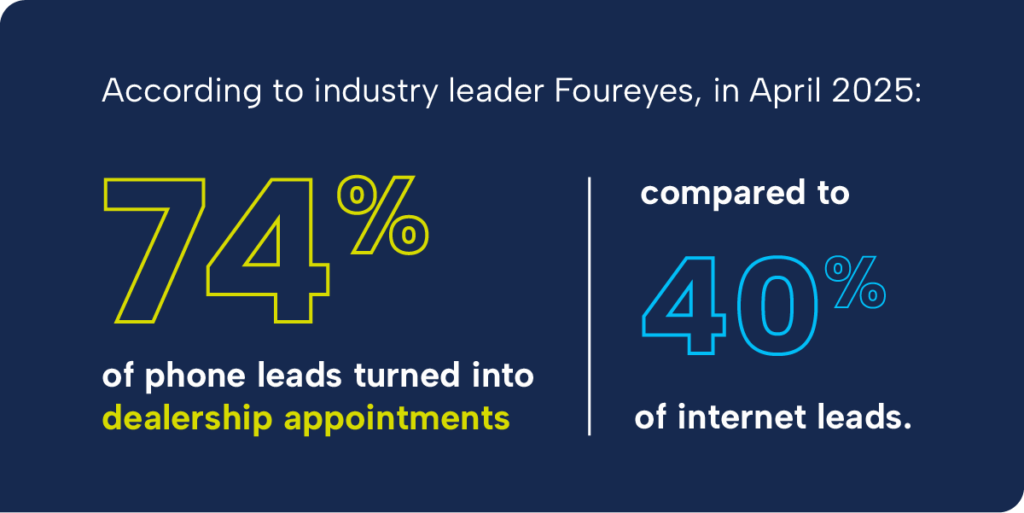
According to industry leader Foureyes, in April 2025, 74% of phone leads turned into dealership appointments, compared to 40% of internet leads. This places a heavier emphasis on phone calls and its importance to the business operation. It is important for dealers to review the workflow of those calls and identify gaps in their processes, especially in stores that have multiple teams touching the same customer.
At the same time, marketing, sales, BDC, and service teams often operate in silos, each with their own metrics and priorities.
Without clear workflow alignment across those touchpoints, even best-in-class platforms struggle to deliver value. They default to being used after opportunities are already missed.
Workflow Alignment Comes First
As you’re likely picking up, before technology can improve performance, leaders need clarity around how work gets done.
That means understanding:
- How calls flow from first contact to outcome
- Who owns each stage of the call journey
- What success looks like at the rep level
- Where coaching and accountability occur
Without this foundation, automation and analytics only add noise. You can’t automate what you don’t understand.
Ntelegence customers who aligned people, process, and technology around a defined call workflow were able to handle 50 percent more customer cases with 25 percent fewer staff, without sacrificing experience. Alignment creates capacity before technology ever does.
Adoption, Buy-In, and WIIFM (What’s In It For Me)
Even aligned workflows fail if people don’t buy in.
Too many rollouts focus on features instead of outcomes. Reps are shown dashboards but not told how those insights help them perform better today. Managers are given data without a clear framework for turning it into action.
When conversation intelligence is used as part of daily coaching and execution, Ntelegence and its partners have observed a 54 percent reduction in administrative workload, freeing reps and managers to focus on customers and performance.
If WIIFM isn’t answered, adoption drops quickly.
Technology that feels like surveillance creates resistance. Technology that supports daily execution earns buy-in.
Where AI Fits and Where It Doesn’t
AI has an important role to play, but it isn’t the answer by itself.
Most automotive customers still expect to speak with real people. High-consideration conversations require judgment, context, and empathy. A fully automated approach introduces risk when those elements are removed.
In hybrid environments supported by Ntelegence and its partners, automation and intelligence tools have helped reduce call handling time by up to 50 percent, while keeping human judgment at the center of high-value conversations.
AI supports performance. It doesn’t replace it.
What a Workflow-First Approach Looks Like
When workflow alignment comes first:
- Reps know expectations before issues arise
- Managers coach from real conversations, not opinions
- Leadership sees quality, not just volume
- Technology supports daily execution instead of post-mortem reporting
Calls become a performance asset, not just a metric.
That’s when call tracking and conversation intelligence start driving revenue execution instead of sitting on the sidelines.
How Automotive Leaders Can Fix It
We ask our clients to take a workflow solution approach whenever they find gaps in their operation. Once they develop this mindset, it is easy to start looking at the right technology that can fulfil their respective strategy.
Dealers who see real results focus on:
- Clarifying workflow before expanding technology
- Aligning expectations across teams and locations
- Launching tools with structure and intent
- Using insights daily, not retrospectively
- Reinforcing adoption through consistent coaching
Across Ntelegence customer engagements, organizations that made this shift also achieved a 20 percent reduction in cost per acquisition, reinforcing the financial impact of proactive execution.
Final Thought
Call intelligence technology doesn’t fail because it isn’t powerful enough. It fails because it is often deployed into a workflow that is not clearly defined, shared, or consistently executed across teams. When that happens, the tool becomes something people review after the fact instead of something they use to drive daily action. Adoption slows down, managers coach inconsistently, and the ROI everyone expected never fully materializes.
When the workflow is visible and aligned, and people know who owns what, how calls should move, and what “good” looks like, the technology finally has something to reinforce. That is when call intelligence shifts from being a reporting layer to becoming a performance driver. It helps teams catch missed opportunities in real time, protect appointments, and improve results without adding more complexity.
About the Author

In 2000, Jeff Scherer helped launch AutoNation Direct, witnessing firsthand how internet and telecommunications technology would revolutionize vehicle sales. Four years later, MarineMax recruited Jeff to build their e-commerce program from the ground up, followed by Bass Pro Shops, where he developed their CRM and online marketing program. In 2008, he founded Teletraxx to deliver custom call management solutions for marine, RV, and powersports dealers.
As automotive clients increasingly sought the same expertise, driven by Jeff’s more than 20 years of industry experience, the company expanded and rebranded as Ntelegence, delivering AI-powered call management and business intelligence solutions for automotive, tire and service, marine, and multi-unit housing industries. Ntelegence specializes in what it calls “micro surgery” rather than commodity solutions, architecting intelligent workflows through conversational AI and proprietary tools such as TeleTraxx for call assessment and PitchPerfect for phone training. The company is guided by a founding principle of “No Dead Ends,” ensuring every customer interaction leads to a meaningful outcome.